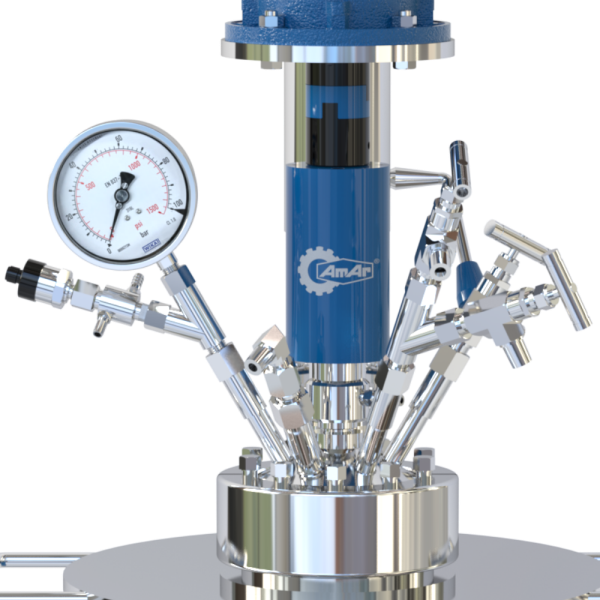
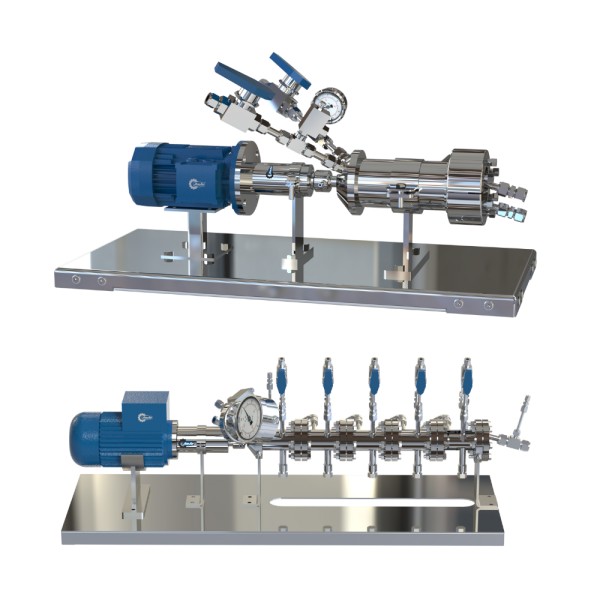
Amar Equipment’s Fluidized Bed Reactors are advanced multiphase reactor systems designed to deliver exceptional heat and mass transfer performance by suspending solid particles in a fluid (gas or gas–liquid) stream. Engineered for efficient and controlled chemical reactions, these reactors promote uniform particle mixing and temperature distribution, making them ideal for high-temperature and high-throughput applications. With customized designs, robust materials of construction, integrated automation, and advanced safety systems, Amar’s fluidized bed reactors support a wide range of thermochemical processes, including combustion, gasification, pyrolysis, and biofuel production. These systems are engineered for reliable operation, precise control, and scalable performance across research, pilot, and industrial continuous processing environments.

A fluidized bed reactor is a multiphase reactor in which solid particles, typically catalyst or granular material, are suspended in an upward-flowing fluid stream, either gas or a gas–liquid combination. When the fluid is passed through the solid bed at sufficient velocity, the solid particles become suspended and behave like a fluid, creating a highly mixed system with excellent heat and mass transfer characteristics.
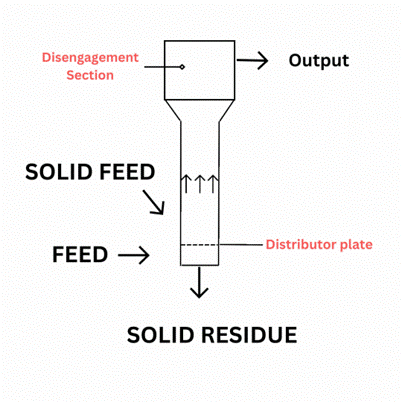
The reactor is generally a vertical cylindrical vessel consisting of two main sections: a reaction section, where the chemical reaction takes place, and a disengagement section, where solids and gases begin to separate. The product exits from the top of the reactor, while solid residue accumulates at the bottom. This configuration ensures uniform particle mixing and uniform temperature gradients throughout the reactor length, enabling efficient and controlled chemical reactions.
In a fluidized bed reactor, the solid material or catalyst is supported on a porous distributor plate located at the bottom of the reactor. A fluid is forced upward through this distributor and into the solid bed. As the fluid velocity increases, it reaches a point where the upward drag force exerted by the fluid equals the weight of the solid particles. This condition is known as incipient fluidization and occurs at the minimum fluidization velocity.
Once this velocity is exceeded, the solid bed expands, particles move freely, and the system transitions into a fully fluidized state. Cyclone separators installed downstream of the reactor capture entrained solids, while the products exiting the cyclone are cooled and collected. Fluidized bed reactor systems are deployed with high levels of safety, integrated controls, and automation to ensure stable and reliable operation.
Amar fluidized bed reactors are custom-designed turnkey systems engineered to meet specific process requirements. These reactors are designed for operation at pressures up to 12 bar and temperatures up to 1200°C. They can handle gas feeds as well as gas–liquid combinations and are fabricated using materials such as glass, SS316, Inconel, Hastelloy, and other specialized alloys.
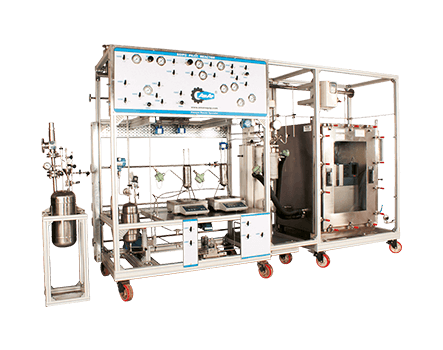
The systems are supplied as skid-mounted plants with single-zone or multi-zone heating arrangements. Integrated automation, advanced safety systems, and SCADA-based monitoring ensure precise control, data logging, and safe operation for high-temperature and multiphase processes.
Fluidized bed reactors provide excellent heat and mass transfer due to uniform particle mixing and high surface area contact between phases. The uniform temperature profile reduces the risk of hot spots, making these reactors particularly suitable for highly exothermic and high-temperature reactions.
They support both batch and continuous solid feeding, enable stable large-scale operation, and allow efficient handling of solid fuels and catalysts. These characteristics make fluidized bed reactors highly efficient, scalable, and well suited for demanding thermochemical processes.
Fluidized bed reactors are widely used across energy, chemical, and biofuel industries. In combustion, they are employed for efficient burning of fuels such as coal and biomass. In gasification, fluidized bed reactors convert coal, biomass, and other feedstocks into synthesis gas (syngas).
They are also used in pyrolysis, where organic materials undergo thermal decomposition at high temperatures in the absence of oxygen. In addition, fluidized bed reactors play a key role in biofuel production, supporting various thermochemical processes that convert waste biomass into liquid and gaseous biofuels.