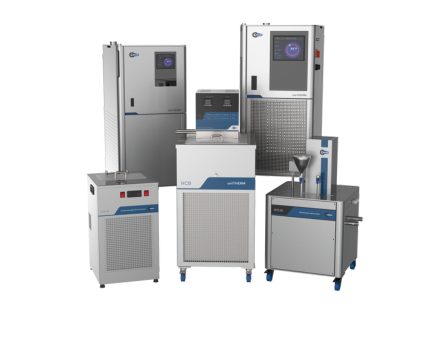
Our Recirculating Chillers (Ambient to –15 °C) are compact cooling units designed for precise temperature control of laboratory and process equipment. These systems circulate chilled fluid through a closed loop to remove heat from reactors, condensers, analytical instruments, and pilot plant systems. Using a refrigeration cycle with compressor, condenser, and evaporator, the chiller continuously absorbs heat from the circulating fluid and dissipates it to maintain stable cooling conditions. The units provide reliable cooling, consistent temperature stability, and efficient operation for laboratory research, process development, and small-scale production applications.
| Specs. | Model | Temperature Range | Heating Power | Cooling Power | Pump Flow | Maximum Pressure | Image | 3D | Enquire |
|---|
A recirculating chiller is a cooling system designed to remove heat from equipment or processes by circulating a cooled liquid through a closed loop. The system uses refrigeration components such as a compressor, condenser, expansion valve, and evaporator to continuously extract heat from the circulating fluid and maintain the required temperature. These chillers are commonly used to provide stable cooling for laboratory instruments, reactors, condensers, and industrial equipment.
Recirculating chillers are typically designed to operate from ambient temperature down to approximately –15°C, depending on the system design and coolant used. This temperature range is suitable for applications requiring controlled cooling such as condensation, instrument cooling, reactor temperature stabilization, and laboratory process development.
Recirculating chillers are used to remove heat from various laboratory and pilot plant systems, including:
By circulating chilled fluid through the equipment, the system maintains stable operating temperatures and prevents overheating of sensitive components.
Using a recirculating chiller provides more consistent temperature control and improved efficiency compared with tap water cooling. Because the coolant is continuously recirculated in a closed loop, the system reduces water consumption while maintaining stable cooling performance. This controlled cooling helps protect equipment from overheating and improves the reliability of laboratory and industrial processes.