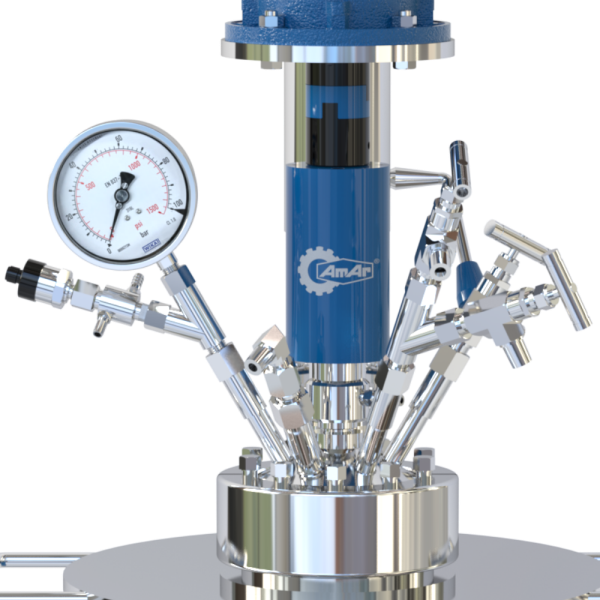
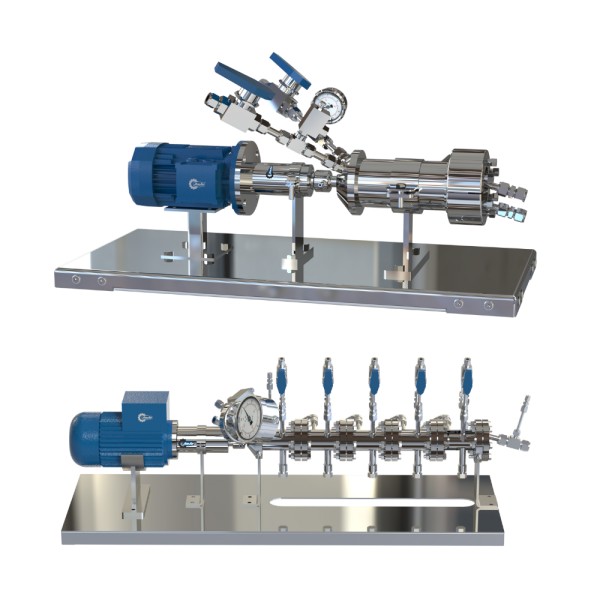
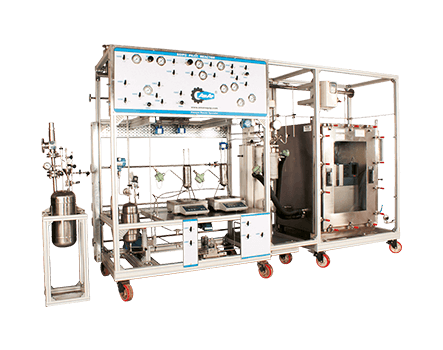
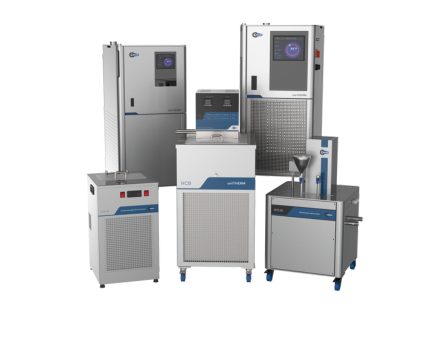
The Amar Continuous Liquid–Liquid Membrane Separator is designed for the continuous separation of immiscible liquid phases in flow chemistry applications. Using a hydrophobic membrane module, it enables efficient separation of organic and aqueous streams without relying on gravity settling, decantation, or centrifugation. The system operates under steady-state conditions, delivering reliable and reproducible phase separation while reducing manual handling and process delays. Its compact, modular design allows easy integration with upstream and downstream flow equipment, supporting a seamless workflow from reaction to extraction and purification. Suitable for both laboratory and pilot-scale use, the membrane separator is ideal for biphasic reactions, aqueous workups, liquid–liquid extraction, and solvent exchange processes. By enabling in-line separation in a continuous format, it improves process efficiency, scalability, and automation in modern chemical manufacturing workflows with greater consistency.
A Continuous Liquid–Liquid Membrane Separator is a device used to separate two immiscible liquid phases, typically an organic phase and an aqueous phase, in a continuous flow process. Instead of waiting for the phases to separate naturally in a settling vessel, the separator performs this step in-line, allowing the process stream to move continuously from reaction to downstream processing. This makes it especially useful in flow chemistry setups where uninterrupted operation, automation, and reproducibility are important.
The separator uses a hydrophobic membrane that selectively allows one liquid phase to permeate while retaining the other. The separation is driven by differences in surface wettability and interfacial tension between the two phases and the membrane surface. As the mixed liquid stream passes through the unit, one phase preferentially moves through the membrane while the other exits through a separate outlet. This allows efficient and continuous phase disengagement under steady-state conditions.
Traditional liquid–liquid separation methods often rely on gravity settling, decanters, or centrifugation. These approaches can be slow, space-consuming, and difficult to integrate into a continuous process. A membrane separator avoids these limitations by providing compact, in-line, and continuous separation. It reduces manual handling, shortens processing time, and improves process consistency. It can also perform better in systems where density differences are small or where emulsions make conventional settling difficult.
The Continuous Liquid–Liquid Membrane Separator is suitable for a variety of flow chemistry applications, including biphasic reactions, liquid–liquid extraction, aqueous workups, solvent exchange, and in-line purification steps. It is particularly valuable when a continuous process requires immediate separation of organic and aqueous streams after reaction. This makes it useful in research, process development, and pilot-scale operations across chemical, pharmaceutical, and fine chemical applications.
Yes. One of the major advantages of membrane-based separation is that it can handle systems that are often challenging for conventional methods. This includes emulsified mixtures or systems where the two liquid phases have closely matched densities. Because the separation is based on membrane selectivity rather than only gravity, the system can provide more reliable phase separation in demanding applications.
Yes. The separator is designed for easy integration with continuous flow reactor systems and downstream modules. It can be connected as part of a larger continuous workflow that includes reaction, extraction, and purification. When integrated with Amar Equipment’s MicroFLO™ reactor, PinchFLO™ reactor, and CorFLO® reactor, it becomes part of a complete continuous processing platform that supports higher productivity, improved safety, and better process control.
Yes. The membrane separator is designed to operate across a wide range of flow rates, making it suitable for both laboratory-scale development and pilot-scale processing. This flexibility allows users to evaluate separation performance during early-stage experiments and then translate the same approach into larger continuous workflows. This makes it a practical tool for scale-up and process intensification.
Yes. Amar Equipment can tailor the membrane separator to suit specific process requirements, including flow rate, phase ratio, and chemical compatibility. This allows the system to be adapted for different solvents, reactants, and operating conditions. Customization helps ensure reliable separation performance while maintaining compatibility with the overall process design.